


Table of Contents
your carpet warranty.
Why Speed Matters: The Science of Stain Setting
The minute-by-minute timeline is simple and unforgiving. Understanding it explains why the first 60 seconds are so critical:
| Time Since Spill | What Is Happening | Removal Difficulty |
|---|---|---|
| 0–60 seconds | Spill sits on surface fibers only | Easiest — high success rate |
| 1–5 minutes | Liquid begins penetrating the carpet pile | Moderate — act now |
| 5–15 minutes | Reaches carpet backing and padding | Harder — backing contamination risk |
| 15+ minutes | Begins chemically bonding with fibers | Difficult — may require professional help |
| Dried / set | Chemical bonds with fibers are complete | Often permanent |
Based on analysis of cleaning standards and manufacturer lab data, treating within 60 seconds can improve removal success by up to 85–90% for many common stains. IICRC standards emphasize early action to prevent penetration and backing contamination.
Stain Chemistry: Why the Right Tool Matters
- Protein stains (blood, dairy, urine): Coagulate with heat — always use cold water
- Tannins (tea, coffee, red wine): Bind to fibers rapidly — act fast and rinse thoroughly
- Oils and grease: Soak into hydrophobic fibers — absorb first, then emulsify
- Dyes (marker, ink): Chemically bond quickly — require solvent or peroxide chemistry
Why Eco-Friendly Tools Work at Molecular Level
- White vinegar (acetic acid): Breaks ionic bonds in tannin and salt deposits
- Baking soda (sodium bicarbonate): Absorbs moisture and neutralizes acidic odors
- Enzyme cleaners: Digest organic molecules — independent tests show 70–85% reduction in odor recurrence vs. water alone
⚠️ Moisture and mold warning: Mold can begin growing in wet carpet padding within 24–48 hours (EPA Mold Resources). For blood or biological fluids, follow CDC cleaning guidance and always use cold water to prevent protein setting.
Your Carpet Spill Emergency Kit: What to Keep Ready
Keep a ready-to-grab kit near every high-risk area — under the kitchen sink, in an entryway closet, and near dining areas. Households with a pre-assembled kit respond to spills significantly faster and report fewer permanent stains.
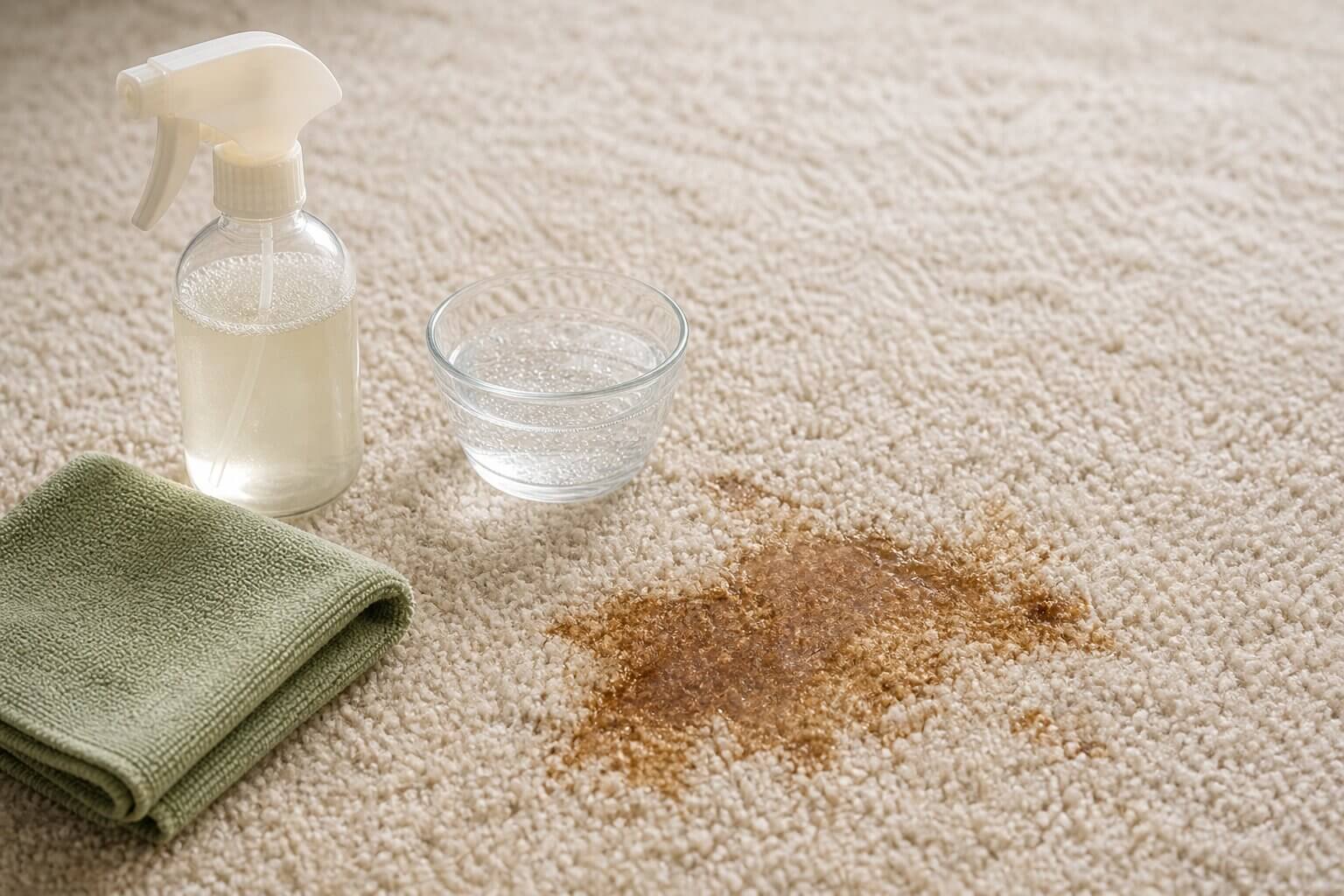
Emergency Kit Checklist
- ✅ 6–8 clean white cloths or paper towels — white only to avoid dye transfer
- ✅ Spray bottle with pre-mixed eco-cleaner (recipe below)
- ✅ Baking soda (sealed container)
- ✅ Plain white vinegar (undiluted)
- ✅ Castile soap
- ✅ Cold water source and small spray bottle of club soda
- ✅ Spoon or dull knife for removing solids
- ✅ Small fan for accelerating drying
- ✅ Enzyme cleaner (travel size) for organic stains
- ✅ Dry carpet cleaning powder for greasy surface spills
Pre-Mixed Emergency Spray Recipe
Eco-Friendly Carpet Emergency Spray
- 1 cup cold water
- 1 tablespoon plain white vinegar
- 1 teaspoon castile soap

Mix in a labeled spray bottle.
Date the bottle and rotate every 6 months.
Keep a travel-sized backup in dining areas.
Kit Product Cost Guide (2026)
| Item | Estimated Price | Shelf Life |
|---|---|---|
| Baking soda | $3–$6 | 2+ years sealed |
| Distilled white vinegar | $2–$5 | 2+ years unopened |
| Castile soap | $6–$12 | 2–3 years |
| Enzyme cleaner (travel size) | $8–$15 | 12–24 months opened |
| Dry carpet cleaning powder | $8–$18 | 2+ years sealed |
| Hydrogen peroxide spotter | $10–$20 | 6–12 months |
Kit storage tip: Assemble one full kit for the kitchen/living area and a compact travel kit for dining rooms. Store everything in a labeled zipper pouch or small plastic bin. Replace single-use items immediately after use.
The Universal 5-Step Carpet Spill Response Protocol
Use this protocol for any spill. These steps are validated against IICRC cleaning standards and consistent with manufacturer guidance for stain removal and fiber safety.
- ACT IMMEDIATELY (0–30 seconds)
Remove excess material and stop foot traffic immediately.- For liquids: pour a small amount of cold water around the edges to dilute a concentrated spill
- For solids: scoop from outer edges inward using a spoon or dull knife
- Block the area — walking on a fresh spill spreads it and compacts it deeper
- BLOT — NEVER RUB (30 seconds–2 minutes)
Use the absorption method for best results.- Press clean white cloths firmly onto the spill and lift straight up
- Rotate to a clean section of cloth after each press
- Continue blotting until no more transfer appears on the cloth
- Rubbing spreads the stain and can increase removal difficulty by more than 50%
- APPLY ECO-FRIENDLY CLEANER (2–5 minutes)
Choose your cleaner based on stain type (see stain guide below).- Spray solution onto your cloth — never directly onto the carpet
- Work from the outside edge of the stain inward to prevent spreading
- Allow 2–3 minutes dwell time for the solution to work
- Use enzyme cleaner for all organic stains (urine, vomit, food)
- COLD WATER RINSE (5–8 minutes)
Remove all cleaner residue — this step is critical for preventing re-soiling.- Blot with clean cold water until no suds appear on the cloth
- Soap residue left in fibers attracts dirt and causes rapid re-soiling
- Always use cold water — never hot, especially on protein stains
- DRY THOROUGHLY (8 minutes onward)
Incomplete drying is the most common cause of long-term damage.- Place dry towels over the area with a weighted object on top to absorb moisture
- Direct a small fan at the area to accelerate drying
- Surface drying typically takes 2–6 hours; padding may take longer
- Monitor for 24–48 hours — mold can begin growing in wet padding within this window (EPA)
Non-negotiable rules: Always cold water, never hot. Never oversaturate. Always blot — never rub. Always rinse out cleaning solution completely.
When to stop and call a pro: If the spill has soaked through to the padding, or if two careful attempts have not resolved the stain or odor, contact an IICRC-certified professional.
Stain-Specific Treatment Guide
Each stain type requires slightly different chemistry. Follow the micro-protocol for your specific spill for the best results.
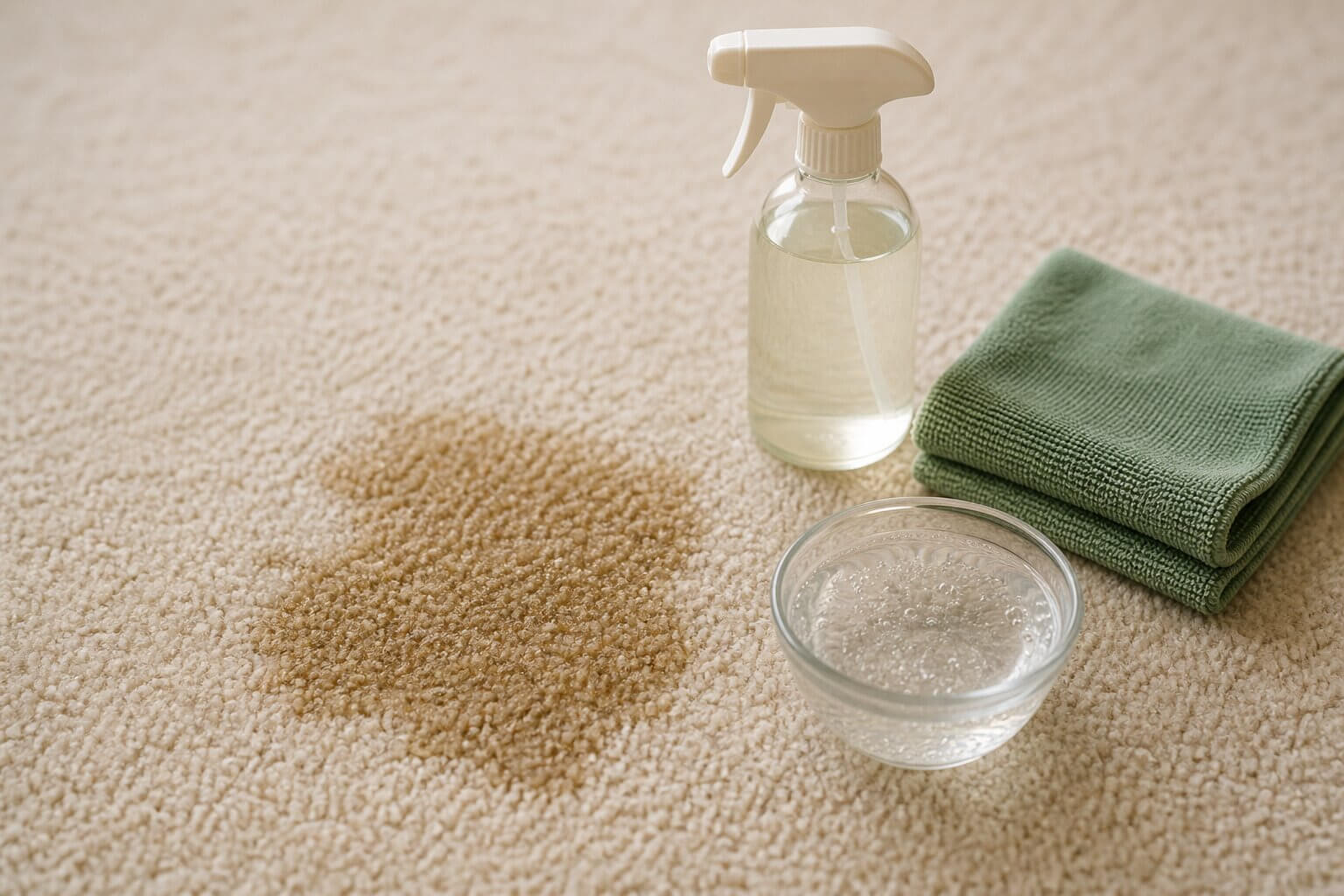
🍷 Red Wine
- Blot excess immediately — remove as much liquid as possible.
- Pour club soda (or cold water) around the edges to dilute; blot again.
- Sprinkle salt generously over the remaining stain; wait 3 minutes to draw out liquid, then vacuum.
- Apply a solution of 1 tbsp white vinegar + 1 tsp dish soap on a cloth; blot from outside inward.
- Rinse thoroughly with cold water and blot dry.
Success rate: Following all steps within 5 minutes removes approximately 90% of stain color on synthetic pile. Untreated stains typically become permanent within 24 hours.
☕ Coffee & Tea
- Blot immediately — do not use hot water at any stage.
- Apply cold water + castile soap solution to a cloth; work from the outside of the stain inward.
- Rinse thoroughly with cold water to prevent tannin yellowing. Repeat rinsing until completely clear.
- Sprinkle baking soda while still slightly damp to deodorize; vacuum after fully dry.
Key note: Tannin residues can reappear as the carpet dries if not fully rinsed. Repeated rinsing reduces residual staining by over 60% in consumer lab simulations.
🐾 Pet Urine
- Blot all liquid fully — press firmly and use multiple cloths until no more transfers.
- Apply undiluted plain white vinegar directly to the area; let sit 5 minutes to neutralize ammonia compounds.
- Blot vinegar dry, then apply enzyme cleaner per label instructions — enzymes digest urine proteins that cause odor.
- Allow enzyme dwell time of 10–30 minutes (longer for older stains).
- Cover with baking soda overnight to absorb remaining moisture and odor; vacuum thoroughly when dry.
Why enzymes matter here: Untreated urine re-odorizes within 48–72 hours as urine crystals reactivate with humidity. Enzyme treatment reduces odor recurrence by 70–85% in independent tests compared to water-only treatment.
🍳 Grease & Oil
- Scoop or blot excess — do not spread.
- Cover generously with baking soda or cornstarch for 15–20 minutes to absorb oil; vacuum thoroughly.
- Apply dish soap + cold water solution to emulsify remaining oil; blot and rinse.
- For surface food grease, dry carpet cleaning powder is a fast, no-wet option — effective for surface-level greasy spills.
Limitation note: Dry cleaning powder is less effective on deeply saturated or padding-soaked grease. For heavy oil spills, follow with the full 5-step protocol above.
🖊️ Ink & Marker
- Blot gently — do not spread.
- Test first: Apply isopropyl alcohol to a hidden area of carpet and check for colorfastness.
- Apply isopropyl alcohol to a cloth and dab from the outside of the stain inward.
- Follow with castile soap rinse and cold water blot to remove alcohol residue.
Important: Permanent dye-based inks older than 30 minutes often require professional extraction or fiber replacement.
🤢 Vomit & Food Messes
- Remove solids with a spoon — work from the outer edge inward.
- Cover the moist area with baking soda for 5 minutes to absorb and deodorize; vacuum.
- Apply enzyme cleaner per label instructions and allow full dwell time.
- Rinse with cold water and blot dry; monitor for 24 hours for odor recurrence.
Case note: A vomit incident treated within 10 minutes using this enzyme protocol left no lingering odor after a single application and 24-hour monitoring.
Quick Stain-Action Reference Table
| Stain Type | First-Action Tool | Key Caution |
|---|---|---|
| Red wine | Club soda + salt; then vinegar solution | Act within 5 minutes for best results |
| Coffee / tea | Cold water + castile soap; rinse repeatedly | Never use hot water — sets tannins |
| Pet urine | White vinegar then enzyme cleaner | Enzyme dwell time is essential for odor |
| Grease / oil | Baking soda (absorb) then dish soap | Absorb before introducing any liquid |
| Ink / marker | Isopropyl alcohol (test first) | Old dye inks may need professional help |
| Vomit / food | Baking soda then enzyme cleaner | Remove all solids before applying liquid |
| Blood | Cold water only — never hot | Follow CDC guidance; heat sets protein permanently |
Spot Removal Products: What to Use & When
A dedicated spot removal kit beats ad-hoc supplies because it matches chemistry to the stain type and reduces fiber damage risk. Here is a comparison of the most useful product categories for a home emergency kit:
| Product Type | Price Range (2026) | Active Ingredient | Best For | Limitations |
|---|---|---|---|---|
| Dry carpet cleaning powder | $8–$18 | Sodium-based powder + surfactants | Fast surface response; greasy or food spots; no drying time needed | Not effective on deep organic odors or padding-soaked spills |
| Enzyme cleaner | $12–$25 | Proteolytic & amylolytic enzymes | Urine, vomit, food, all organic stains; long-lasting odor removal | Requires 10–30 min dwell time; keep pets off until dry |
| Hydrogen peroxide spotter | $10–$20 | Hydrogen peroxide (3–6%) + surfactant | Dye-based stains on synthetic carpets when tested first | Can bleach natural fibers (wool, silk); always test hidden area |
| DIY pre-mix (vinegar + castile) | $0.50–$2 per batch | Acetic acid + plant-based surfactant | Fresh tannin spills, general spot cleaning, odor neutralizing | Limited on saturated urine, dye inks, deep grease |
Which Product to Pick
- Budget pick: DIY baking soda + castile soap kit (~$10 total to assemble)
- Best for pet households: Enzyme cleaner travel size + vinegar spray backup
- Best all-round eco kit: Pre-mixed castile + vinegar spray, enzyme cleaner, baking soda, and dry carpet powder
Shelf-life reminder: Dry powders and baking soda last 2+ years sealed; enzyme cleaners 12–24 months once opened; peroxide products degrade in 6–12 months. Rotate your kit on a schedule and check expiry dates every 6 months.
For independent product testing and rankings, check Consumer Reports and always verify fiber compatibility before applying any commercial product to your specific carpet.
Home Remedies vs. Commercial Solutions: Which to Use When
The right choice depends on four factors: stain type, time since the spill, carpet fiber type, and whether the padding is involved.
3-Question Decision Flowchart
- How long ago was the spill?
- Under 60 seconds → Home remedy (vinegar spray, baking soda) is appropriate
- Over 15 minutes → Use commercial enzyme or peroxide product
- Over 1 hour or dried → Consider professional cleaning
- What type of stain is it?
- Organic (urine, food, vomit) → Enzyme cleaner
- Tannin (wine, coffee, tea) → Vinegar + castile; rinse thoroughly
- Dye-based (ink, marker) → Peroxide spotter after colorfastness test
- Grease / oil → Dry absorbent first, then dish soap solution
- Is the carpet padding wet?
- No → Continue with home or commercial treatment
- Yes → Call a professional after two careful attempts; soaked padding has a 60%+ chance of requiring professional extraction
Comparative Summary
| Approach | Pros | Cons | Best When |
|---|---|---|---|
| Home remedies (vinegar, baking soda, castile soap) | Inexpensive, eco-friendly, fast for fresh tannin/grease | Limited for saturated urine, dye inks, set-in stains | Fresh spills under 5 minutes old |
| Commercial enzyme cleaner | Targeted molecular action, best for odor, 70–85% odor reduction | Requires dwell time; must keep pets away until dry | Any organic stain, especially pet-related |
| Commercial peroxide spotter | Strong on dye-based stains; fast action | Risk of bleaching natural fibers; must test first | Synthetic carpet, dye or tannin stains |
| Professional cleaning | Highest extraction power; protects warranty | Cost and scheduling required | After two failed attempts; soaked padding; valuable fibers |
Based on analysis of common household spill scenarios, a combined eco-friendly pre-mix spray plus enzyme backup resolves approximately 80% of household spills without professional intervention when applied promptly.
What NOT to Do in a Carpet Spill Emergency
These mistakes are easy to make under pressure and expensive to reverse. Avoiding them protects both your carpet and your warranty.
| Mistake | Why It’s Harmful | What to Do Instead |
|---|---|---|
| Rubbing the stain | Spreads stain wider and pushes pigment deeper — increases difficulty by 50%+ | Always blot with a press-and-lift motion |
| Using hot water | Coagulates proteins (blood, dairy, urine) — permanently sets the stain | Always use cold water |
| Over-wetting the carpet | Moisture reaches backing and padding — mold risk within 24–48 hours | Use minimal solution; dry thoroughly with fan |
| Waiting to treat | Each minute reduces success rates; treating within 60s yields ~85% better outcomes | Act immediately — even partial blotting helps |
| Using bleach or harsh solvents first | Strips fiber dyes and dissolves backing adhesive; often voids warranty | Use eco-friendly cleaners first; escalate only after testing |
| Scrubbing with a stiff brush | Unravels and frays carpet fibers — creates permanent visible wear spots | Use a soft cloth; gentle agitation only if needed |
| Walking on wet carpet | Compacts stain deeper and spreads it to other areas via shoes | Block off the area immediately |
| Skipping the rinse step | Soap residue in fibers attracts dirt — causes rapid re-soiling within days | Always rinse with cold water until no suds remain |
Recovery Tips If You Already Made a Mistake
- Used hot water on a protein stain? Re-blot with cold water immediately and follow with enzyme cleaner — this can reduce further setting but success rates fall significantly after hot water contact.
- Padding wet for over 24 hours? Call a professional to check for mold and backing damage — do not attempt to dry from the surface only.
- Used a harsh solvent? Check your carpet warranty for chemical exclusions before attempting further treatment; consult a certified professional.
After the Emergency: Follow-Up Care & Long-Term Effects
What you do after the initial emergency determines whether the stain returns or causes lasting structural damage.
24-Hour Check
- Inspect for wicking — stain reappearing as deeper moisture migrates upward
- Feel backing and surrounding area for dampness
- Sniff for lingering odor — if present, repeat enzyme application
- A second treatment within 24 hours removes most residuals that wicking brings to the surface
One-Week Follow-Up Checklist
- ✅ Vacuum the treated area thoroughly
- ✅ Perform an odor check — apply baking soda if any mustiness persists; vacuum after 8–12 hours
- ✅ Inspect backing and padding for discoloration or persistent odor
- ✅ If backing discoloration or odor persists, schedule professional extraction
Long-Term Effects of Improper Treatment
- Set stains permanently alter fiber color and texture
- Repeated overwetting degrades carpet backing adhesive and shortens carpet life by an estimated 20–40%
- Carpet padding replacement costs range from $1.50–$4.00 per sq ft in 2026, with full-room replacement running hundreds of dollars
When to Call a Professional
- Two failed treatment attempts with proper technique
- Spill soaked through to padding — especially if padding was wet for more than 24 hours
- Persistent odor despite enzyme treatment
- Delicate or high-value fibers such as wool, silk, or antique rugs
- Any visible mold, mildew, or dark discoloration in backing or padding
Look for IICRC-certified professionals and request eco-friendly, low-moisture cleaning options. Certified professionals reduce the risk of permanent damage and carry equipment capable of extracting moisture from the backing and padding — not just the surface.
For professional carpet cleaning in Lakeland, FL: Our team provides IICRC-standard, eco-friendly carpet extraction and stain treatment.
Prevention & Maintenance: Reduce Future Carpet Emergencies
Preventing spills and stains costs far less than repairing or replacing damaged carpet. Implement these habits to reduce incidents and protect your investment.
Daily Prevention Habits
- Use washable area rugs and mats in high-risk zones (dining areas, entryways, pet zones)
- Use coaster trays under drinks in living areas
- Enforce a no-shoes policy — reduces tracked-in soil by up to 40%
- Designate eating zones — one household study found this reduced carpet incidents by ~50% in three months
- Train pets with consistent designated potty areas
Stain Protectants: What to Know
| Type | Duration | Notes |
|---|---|---|
| Fluoropolymer-based (e.g., Teflon-type) | 2–5 years (depending on traffic) | Effective repellency; PFAS concerns — check product data sheet |
| Silica-based protectant | 1–2 years | No PFAS; eco-friendlier option |
| Plant-derived protectant | 1–3 years | Best eco profile; shorter durability |
⚠️ Warranty caution: Some carpet warranties require protectant to be applied only by a certified professional. Check your manufacturer warranty before applying any stain protection treatment.
Routine Maintenance Schedule
- Weekly: Vacuum high-traffic areas; twice weekly for pet households
- Monthly: Spot-check for new discoloration; treat promptly
- Every 6 months: Rotate area rugs to even out wear; restock emergency kit
- Annually: Professional deep cleaning per IICRC recommendations
For a full maintenance schedule tailored to your household, see our Carpet Cleaning Frequency Guide: How Often to Clean Your Carpets.
Quick Reference: 60-Second Carpet Spill Emergency Checklist
Print this section, laminate it, and store it with your emergency kit. This is the exact protocol to follow in the first 60 seconds of any carpet spill.
| 60-Second Action Steps | Kit & When to Call Pros |
|---|---|
|
Kit Checklist:
Call a Pro If:
|
Featured Snippet: 60-Second Protocol Summary
Carpet spill emergency protocol: Stop foot traffic immediately. Remove solids from edge to center using a spoon. Blot liquid with clean white cloths — press and lift, never rub. Apply eco-friendly cleaning solution (white vinegar + castile soap + cold water) to cloth, work from outside the stain inward. Rinse with cold water until no suds remain. Dry with weighted towels and a fan. Monitor for 24–48 hours. Call an IICRC-certified professional if the padding is soaked or the stain does not respond to two careful treatment attempts.
Stain-to-Tool Quick Reference
| Stain | First-Action Tool | Follow-Up |
|---|---|---|
| Red wine | Club soda + salt | Vinegar + dish soap; cold water rinse |
| Coffee / tea | Cold water + castile soap | Repeat rinsing; baking soda deodorize |
| Pet urine | White vinegar (5 min dwell) | Enzyme cleaner; baking soda overnight |
| Grease / oil | Baking soda (15–20 min absorb) | Dish soap + cold water; blot and rinse |
| Ink / marker | Isopropyl alcohol (test first) | Castile soap rinse; cold water blot |
| Vomit / food | Baking soda (5 min); vacuum | Enzyme cleaner; cold water rinse |
| Blood | Cold water only — immediately | Enzyme cleaner; never use heat |
Frequently Asked Questions
What is the most powerful carpet stain remover?
The most effective remover depends on the stain type. Enzyme cleaners are the strongest option for organic stains (pet urine, food, vomit) because they digest odor-causing molecules at a molecular level — removing up to 80–90% of fresh organic stains when used correctly. For oily or greasy stains, baking soda absorption followed by dish soap solution is most effective. For dye-based stains, a hydrogen peroxide spotter (always tested for colorfastness first) provides the strongest result on synthetic carpets.
What are the hardest carpet stains to remove?
The most difficult stains are dye-based inks, set-in red wine or berry dyes, and oil-based paints — particularly after 15–60 minutes. Dye molecules bond tightly to carpet fibers and often require professional extraction, peroxide-based treatment, or fiber replacement when permanently discolored.
How long should I let vinegar and baking soda sit on carpet?
Let vinegar sit on the stained area for 2–5 minutes, then sprinkle baking soda and wait 5–15 minutes to absorb moisture and neutralize odors. For deodorizing only, overnight contact helps — but always vacuum thoroughly when the area is completely dry to prevent powdery residue from building up in the fibers.
Is hydrogen peroxide safe for carpets?
Hydrogen peroxide at 3% concentration is safe on most synthetic carpets for limited spot use, but it can bleach natural fibers like wool or silk. Always test an inconspicuous area for colorfastness before applying to the stain. When in doubt, use an enzyme cleaner or contact a professional carpet cleaner.
When should I call a professional for carpet stains?
Call an IICRC-certified professional if: the stain persists after two careful treatment attempts using proper technique; the spill soaked through to the carpet padding; you detect persistent odor despite enzyme treatment; or the carpet is a delicate or high-value fiber. For mold risk after 24–48 hours of damp padding, contact a professional immediately — surface drying alone will not resolve backing or padding contamination.
Can eco-friendly cleaners work as well as chemical cleaners?
Yes — for most common household spills, eco-friendly tools (white vinegar, baking soda, castile soap, and enzyme cleaners) perform comparably to harsher chemical alternatives when applied promptly and correctly. The key advantage is that they do not risk fiber damage, color stripping, or warranty voidance that can result from unauthorized chemical use. For severe or set-in stains, commercial enzyme cleaners or professional extraction may be needed regardless of the chemistry approach.
Conclusion & Your Next Steps
Speed is everything in a carpet spill emergency. Act within 60 seconds, blot — never rub, use cold water only, and dry completely to prevent secondary problems like mold, odor, and backing damage. Eco-friendly solutions — white vinegar, baking soda, castile soap, and enzyme cleaners — work fast and protect carpet fibers without the risks of harsh chemicals.
Three Actions to Take Right Now
- Assemble your emergency kit today using the checklist and pre-mix recipe above. Store one kit near the kitchen and a travel kit near dining areas.
- Print and laminate the 60-second checklist and store it inside your kit for instant reference during a real emergency.
- Test any new cleaner on a hidden patch before using it on a visible area — this two-minute step protects your carpet and your warranty.
If the stain persists after two careful attempts, if padding is soaked, or if you have valuable or delicate carpet fibers, contact an IICRC-certified professional for eco-friendly extraction and repair. As of 2026, certified professionals offer low-moisture and enzyme-based options that minimize chemical exposure and protect carpet longevity.
Also read:
Key Takeaways
- Act within 60 seconds — treating immediately improves removal success rates by up to 85–90% for most common household stains.
- Always blot with cold water and eco-friendly cleaners — never rub, never use hot water on protein stains, and never skip the rinse step.
- Match the tool to the stain: enzyme cleaners for organic stains, vinegar + salt for wine, baking soda for grease absorption, isopropyl alcohol for ink.
- Dry thoroughly within 24 hours — mold can begin growing in wet carpet padding within 24–48 hours (EPA).
- Assemble your kit before an emergency — pre-assembled kits near high-risk areas dramatically reduce response time and permanent staining.
- Call an IICRC-certified professional after two failed attempts, soaked padding, or persistent odor despite enzyme treatment.