


The Core Difference: Why These Two Are Not the Same
One of the most common and damaging mistakes homeowners make is treating an area rug exactly like wall-to-wall carpet. Both sit on your floor. Both collect dirt, allergens, and pet hair. But the similarities end there.
Wall-to-wall carpet is typically synthetic broadloom — nylon, polyester, or olefin — bonded to a stable backing and padding system that stays put. It tolerates hot water extraction, higher-pH cleaning chemistry, and significant moisture volumes because it is designed for in-place cleaning and fast forced-air drying.
Area rugs are a different category entirely. Natural fiber rugs — wool, silk, viscose, jute, cotton — have specific fiber chemistries that react badly to the wrong water volume, the wrong pH, and the wrong drying conditions. Hand-tufted rugs are held together with latex backing that can delaminate under excess saturation. Dyes that are stable under gentle rinsing can bleed under aggressive extraction. Viscose fibers weaken severely when wet.
The eco-friendly cleaning differences between the two types flow directly from these physical realities — and understanding them is the difference between cleaning that extends your carpet’s life and cleaning that destroys it.
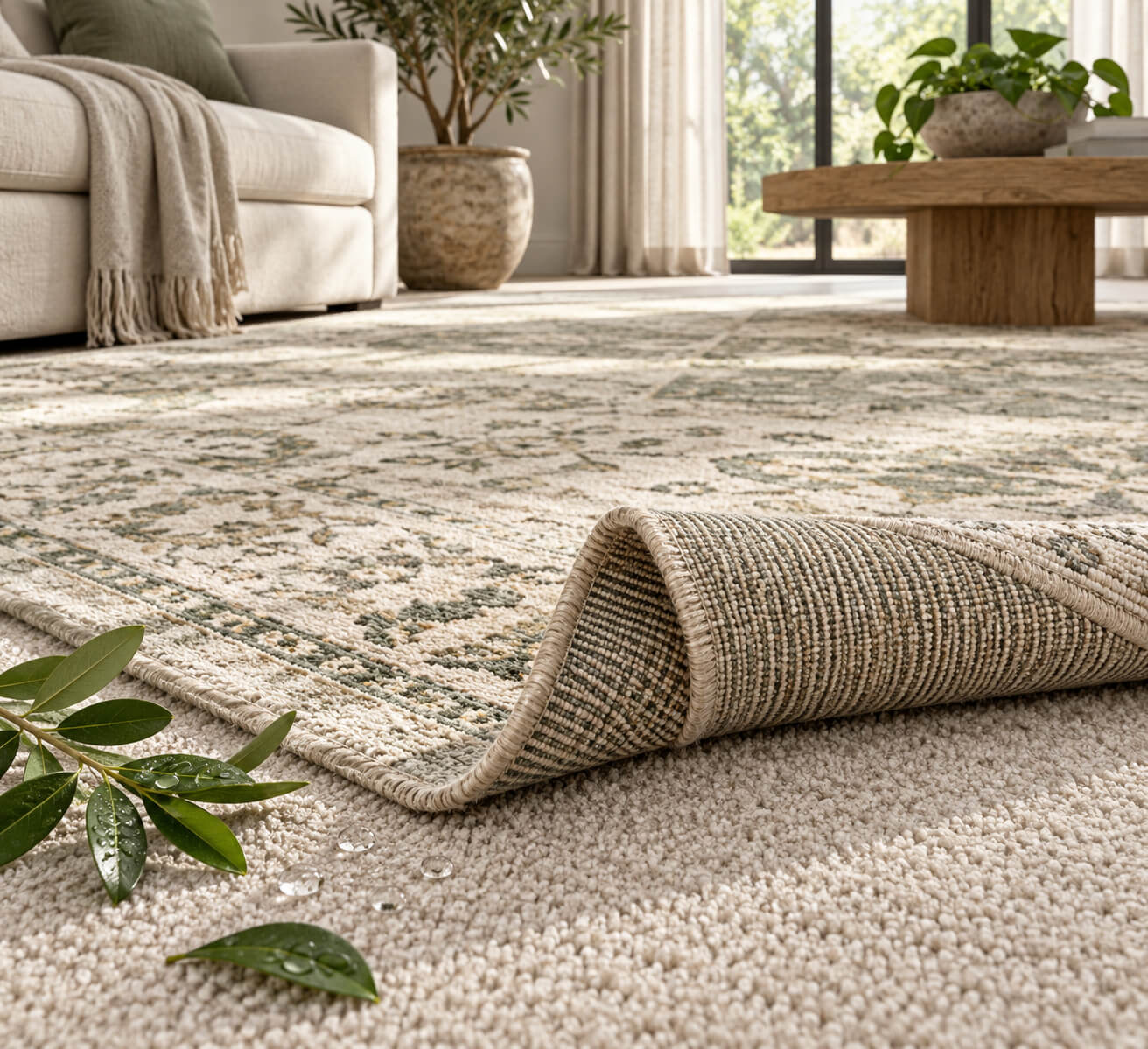
Cleaning Location: On-Site vs. Off-Site
Wall-to-wall carpet is always cleaned on-site. It cannot be removed — and it does not need to be. Hot water extraction performed in place reaches deep into carpet fibers and the underlayment padding where bacteria, allergens, and embedded soil accumulate. The carpet’s stable backing and the ability to use fans and HVAC systems to force-dry the area make on-site cleaning effective and practical.
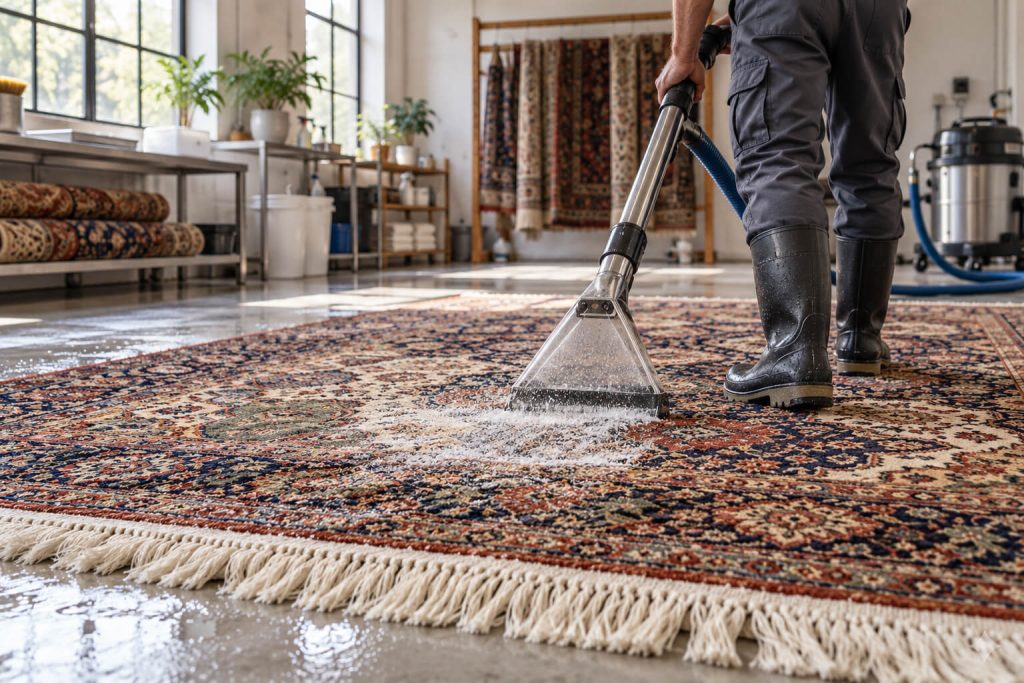
Quality area rug cleaning — particularly for natural fiber and delicate construction rugs — happens off-site at a specialist cleaning facility. This is not a logistical convenience; it is a cleaning requirement. Off-site processing allows for:
- Pre-cleaning inspection: Assessment of fiber type, dye stability, construction, and existing damage before any solution is applied. One specialist service performs an in-depth inspection on all area rugs to assess the fabric, condition, exact dye type, and any spots, stains, or damage before selecting a cleaning method
- Mechanical dusting: Specialist equipment removes embedded particulate matter from deep within the pile — including filth that traditional vacuum cleaners miss — before wet cleaning begins
- Controlled immersion and rinsing: Full liquid submersion with precise water volume, temperature, and pH management — not possible in a home environment
- Facility drying: Climate-controlled drying environments that prevent mold, fiber distortion, and backing damage — critical for rugs that cannot be laid flat in a home and force-dried quickly
- Final inspection and packaging: A post-clean inspection before the rug is rolled, packaged, and returned — protecting it during transport back to your home
All Green Carpet Clean describes most area rug cleaning as taking between 7 and 10 days for this full process — inspection, dusting, cleaning, rinsing, grooming, and controlled drying — with free pickup and delivery included. Karma Carpet Cleaning in Los Angeles operates a faster in-home service for rugs in standard condition, using truck-mounted steam cleaning with powerful suction to remove most of the water so the rug dries quickly — though they note that rugs with urine or very difficult stains are better handled via their pickup and drop-off service.
The practical implication: If a company offers to clean your Persian wool rug on-site in the same session as your fitted bedroom carpet, ask specifically how they are adjusting their process for the rug’s fiber type and backing construction. In-place extraction with standard carpet chemistry on a natural fiber rug is where fiber damage begins.
Fiber Sensitivity and Eco Chemistry: Why the Same Product Does Not Work on Both
This is the most important section for anyone choosing eco-friendly cleaning products or services — because the chemistry that is safe and effective on synthetic wall-to-wall carpet can permanently damage a natural fiber area rug.
What Happens to Natural Fiber Rugs with the Wrong Chemistry
- High-pH detergents designed for synthetic broadloom strip the natural lanolin oils from wool and silk fibers, causing yellowing, brittleness, and permanent texture damage
- Excess water volume causes viscose (rayon) fibers to weaken severely — making aggressive extraction a direct route to fiber breakdown and pile distortion
- Over-saturation of hand-tufted rugs reaches the latex adhesive that holds the pile to the backing — once latex delaminates, the rug’s structural integrity is compromised and cannot be restored
- Untested dye chemistry on handmade or naturally dyed rugs can result in dye bleed under water temperatures and pressures that synthetic carpet tolerates without issue
- Bleach, ammonia, and high-sudsing cleaners strip colors, weaken fibers, and leave sticky residue that attracts future soiling faster than the original dirt — these should be avoided on any rug regardless of fiber type
What Eco-Friendly Chemistry Actually Means for Each Surface
For wall-to-wall synthetic carpet: Biodegradable, plant-derived surfactants at a moderately alkaline pH work effectively on nylon and polyester broadloom. Low-foaming formulas are safe in extraction machines. The fiber tolerates more aggressive agitation and water volume, allowing thorough soil removal with faster drying.
For natural fiber area rugs: Eco-friendly cleaning requires pH-neutral to mildly acidic formulas that match the fiber’s natural chemistry. Wool’s natural pH sits around 4.5–5.5, making alkaline carpet shampoos directly damaging. Biodegradable enzyme-based solutions or gentle organic formulas are appropriate for most natural fiber types. Karma Carpet Cleaning uses specialized chemicals depending on the fiber type to deliver results without harmful chemicals or risk of damage. All Green Carpet Clean applies a gentle organic cleaning solution with a heated pre-treatment for stains, spots, and pet urine. Dye-stability and fiber-compatibility testing must precede any solution application — one specialist service tests each rug before cleaning specifically to reduce the risk of damage.
Eco-Friendly Wall-to-Wall Carpet Care: What Works
Wall-to-wall carpet’s synthetic construction makes it the more forgiving of the two surfaces for DIY eco-friendly maintenance. These methods are effective and low-impact when applied correctly.
Routine Maintenance
- HEPA-filter vacuuming: Make a minimum of three passes with a HEPA-filter vacuum before any wet cleaning. HEPA filtration prevents re-depositing fine particulate back into the air — important for allergen control in households with pets or asthma sufferers. Three passes in alternating directions removes significantly more embedded debris than a single pass
- Baking soda odor treatment: Sprinkle baking soda liberally over carpet and allow to sit for 2–12 hours — overnight is ideal for pet odors or musty smells. Vacuum thoroughly afterward. Baking soda neutralizes acidic odor compounds without introducing any chemical residue
- Vinegar spot spray: Mix 1 cup white vinegar with 1 cup warm water (add one drop of mild dish soap for greasy spots). Apply to the affected area, allow 5–10 minutes dwell time, then blot from the outside of the stain inward. Do not rub. Vinegar’s mild acidity breaks down alkaline residues left by pet urine and common food spills
Deep Cleaning
- Eco pre-spray dwell time: When using a biodegradable pre-spray before hot water extraction, allow 10–15 minutes of dwell time before running the extractor. Gentler plant-derived formulas require longer contact time to break down soil bonds — skipping or shortening dwell time is the most common reason eco-friendly products appear to underperform
- Final rinse pass: Run a pure water-only pass as the final extraction cycle. This flushes detergent residue from the fiber without leaving soil-attracting chemical deposits — a step that most DIY users skip but that makes a measurable difference in how quickly carpet re-soils after cleaning
- Low-moisture encapsulation: For households wanting to minimize water use, low-moisture encapsulation is a sustainable deep-clean alternative. Biodegradable plant-derived crystallizing polymers surround soil particles and are vacuumed away once dry. Orbital technology keeps water use minimal and eliminates toxic chemical runoff. Drying time is typically 30–60 minutes versus 6–12 hours for full hot water extraction
Eco-Friendly Area Rug Care: What Works
Area rug maintenance requires more caution but is highly manageable at home for routine upkeep — with professional off-site cleaning reserved for deep cleans and delicate or valuable rugs.
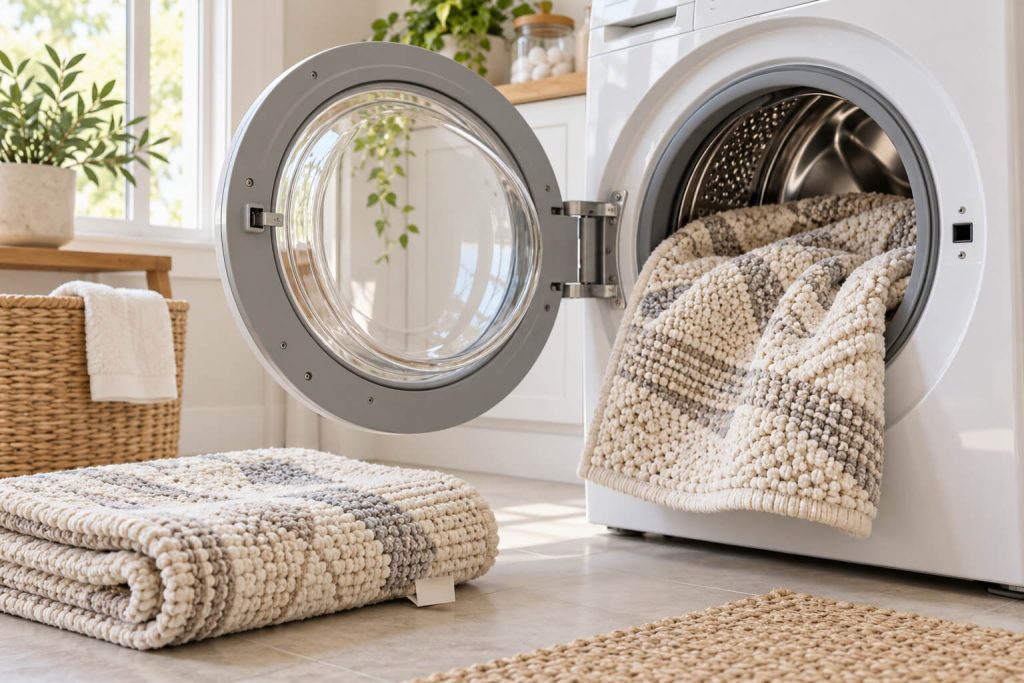
Routine Maintenance
- HEPA vacuum — both sides: Vacuum the pile side first with a HEPA-filter vacuum using a lower suction setting for delicate fibers. Then carefully flip the rug and vacuum the back — this dislodges deeply embedded particulate that pile-side vacuuming alone cannot reach. Professional cleaners use heavy-duty dusting equipment for this step because traditional vacuums miss deeply embedded filth in the rug’s foundation
- Manual beating: Hanging a rug outdoors and beating it with a rug beater or broom handle is an effective low-energy alternative to vacuuming for removing embedded dry debris. This traditional method uses zero electricity and no chemistry — genuinely the most eco-friendly maintenance option available for loose debris removal
- Sunlight disinfection: Natural sunlight reduces minor odors and discourages bacterial growth without any chemical input. Lay the rug pile-side down in direct sunlight for 2–4 hours. Rotate the rug during this process to distribute the effect evenly and avoid uneven fading on dyed fibers
- Baking soda overnight treatment: The same baking soda method used for wall-to-wall carpet applies to area rugs — sprinkle, allow 2–12 hours, vacuum thoroughly. For wool rugs, use a lower-suction setting when vacuuming the baking soda out to avoid pulling pile fibers
- Vinegar spot spray: The same 1:1 vinegar and water formula used for fitted carpet applies to most synthetic area rugs. For wool or silk rugs, dilute further — 1 part vinegar to 3 parts water — and test on a hidden corner first before applying to any visible area
Deep Cleaning
- Always test first: Before applying any cleaning solution to an area rug, test on a small, hidden section of fiber. Apply the solution, allow the intended dwell time, blot with a white cloth, and check for dye transfer or fiber change. This step is non-negotiable for natural fiber or hand-dyed rugs
- Avoid rental carpet machines on delicate rugs: Rental machines are one of the leading causes of area rug damage — they apply more water than most rug backings can safely handle, and trapped moisture under a rug creates mold risk within 24–48 hours. For rugs suitable for at-home spot cleaning, low-moisture extraction tools are significantly safer
- Professional immersion cleaning for deep cleans: For wool, silk, viscose, jute, Persian, Oriental, hand-knotted, antique, or pet-urine-saturated rugs, professional off-site immersion cleaning is the correct approach. The controlled facility environment manages every variable — water temperature, pH, agitation, and drying — that determines whether a deep clean restores or damages the rug. Most rugs should dry within 24 hours after professional cleaning, though drying time varies with rug type and the cleaning method used
Side-by-Side Comparison: Area Rug vs. Wall-to-Wall Carpet
| Factor | Wall-to-Wall Carpet | Area Rug |
|---|---|---|
| Cleaning location | Always on-site | Routine maintenance on-site; deep cleaning off-site for natural fibers |
| Water volume risk | Lower — synthetic fibers and stable backing tolerate extraction moisture | Higher — over-wetting risks latex delamination, fiber weakening, and mold |
| Safe pH range | Moderately alkaline (pH 8–10) tolerated by synthetic fibers | pH-neutral to mildly acidic for natural fibers; always test first |
| Safe DIY chemistry | Biodegradable surfactants, baking soda, diluted vinegar, enzyme cleaners | Baking soda, diluted vinegar (test first), pH-neutral enzyme formulas only |
| Pre-clean routine | 3-pass HEPA vacuum | HEPA vacuum both sides; manual beating as low-energy alternative |
| Professional method | Hot water extraction on-site; low-moisture encapsulation | Off-site immersion cleaning with pH-controlled rinsing and facility drying |
| Drying considerations | Fans and HVAC; 6–12 hours for extraction; 30–60 min for encapsulation | Facility-controlled drying; 24 hours minimum; mold risk if under-dried |
| Fiber testing required | Recommended; rarely critical for standard synthetic broadloom | Essential before any solution is applied to natural fiber or dyed construction |
| Eco maintenance extras | Low-moisture encapsulation; pure water rinse pass | Sunlight disinfection; rug rotation; manual beating |
The Environmental Case for Doing This Right
Proper cleaning technique is not only about fiber preservation — it is directly connected to environmental impact.
The U.S. EPA reports that over 4 billion pounds of carpet enter the U.S. municipal solid waste stream annually — more than 1% by weight and 2% by volume of total solid waste. The single most effective way to reduce a household’s contribution to that figure is to maintain carpets and rugs correctly, extending their usable life rather than replacing them prematurely due to cleaning damage or neglect.
Beyond waste reduction, the cleaning method itself carries an environmental footprint:
- Low-moisture encapsulation for wall-to-wall carpet uses a fraction of the water required by conventional hot water extraction and eliminates the chemical runoff associated with high-volume extraction
- Biodegradable, plant-derived cleaning formulas break down in wastewater treatment without contributing persistent chemical compounds to waterways — unlike some conventional surfactants and solvent-based cleaners. Karma Carpet Cleaning specifically notes that their eco-friendly cleaning agents are 100% natural and safe for babies, pets, and the elderly
- Green Seal certification (standards GS-52 and GS-53 for products; GS-37 for commercial cleaning services) verifies that certified products contain no intentionally added PFAS chemicals — the “forever chemicals” now found in municipal water supplies — and can contribute up to 5% of LEED certification points for sustainable building operations
- Eco-friendly cleaning takes longer — gentle micro-splitting formulas that rely on biodegradable chemistry require up to twice the dwell time of conventional cleaners. This is a feature, not a flaw: extended contact time replaces chemical aggressiveness with chemistry time, reducing the total chemical load needed to achieve the same result
The most sustainable choice of all is extending carpet and rug life. A rug cleaned correctly every 12–18 months and maintained properly between cleans can last decades. The same rug cleaned with the wrong chemistry once may need replacement within a year.
When to Call a Professional
DIY eco-friendly maintenance handles the majority of routine carpet and rug care effectively. Professional cleaning becomes the right call in these situations:
For Wall-to-Wall Carpet — Call a Professional When:
- Annual or 18-month deep cleaning is due depending on household traffic and pet ownership
- Pet urine has saturated through to the padding — enzyme DIY treatment addresses surface contamination but padding saturation requires professional extraction
- Persistent odors return after DIY treatment — indicating contamination deeper than surface fiber level
- Visible traffic lane darkening that DIY vacuuming and spot cleaning cannot lift
For Area Rugs — Call a Professional When:
- The rug is made from wool, silk, viscose, jute, or any natural fiber
- The rug is hand-knotted, Persian, Oriental, antique, or of significant monetary or sentimental value — All Green Carpet Clean holds IICRC certification specifically covering Persian rug cleaning, Oriental rug cleaning, and general rug cleaning
- Pet urine contamination is present — urine crystals that have set into natural fiber pile require professional enzyme treatment and controlled rinsing that exceeds DIY capability. Karma Carpet Cleaning notes that rugs with urine or very difficult stains are better handled via pickup and drop-off service
- The rug smells unpleasant, looks dull, or sends up dust clouds when shaken — visible signs that embedded contamination has exceeded what routine maintenance can address
- Any time you are uncertain about the fiber type or dye stability — a professional inspection costs less than replacing a damaged rug
When selecting a professional cleaner, ask specifically about their approach to eco-friendly cleaning and whether they use Green Seal certified products. For area rugs, confirm that off-site processing includes fiber testing before any solution is applied and controlled facility drying — not simply a longer on-site extraction session.
For professional carpet and rug cleaning in Lakeland, FL, see our guide to choosing the right eco-friendly carpet cleaning service.
Frequently Asked Questions
Can I clean my area rug the same way I clean wall-to-wall carpet?
No — and the difference matters for both cleaning results and fiber safety. Wall-to-wall carpet is cleaned in place using hot water extraction, which works because synthetic broadloom tolerates more water and agitation. Area rugs — especially natural fiber rugs made from wool, silk, or viscose — often require off-site cleaning in a controlled facility where water volume, pH, and drying conditions can be managed precisely. Using wall-to-wall carpet chemistry on a delicate area rug risks fiber damage, dye bleeding, latex delamination, and mold from over-wetting.
What eco-friendly methods work for wall-to-wall carpet maintenance?
For routine maintenance: vacuum with a HEPA-filter vacuum making at least three passes before any wet cleaning. For odor control, sprinkle baking soda over the carpet and allow it to sit 2–12 hours before vacuuming. For spot cleaning, mix 1 cup white vinegar with 1 cup warm water. For deep cleaning, low-moisture encapsulation uses biodegradable plant-derived formulas and orbital technology to minimize water use. Always follow extraction with a pure water rinse pass to flush detergent residue.
Why do natural fiber area rugs need different cleaning chemistry?
Natural fibers — wool, silk, viscose, cotton — react very differently to water and cleaning chemistry than synthetic broadloom. Viscose fibers weaken severely when wet. Hand-tufted rugs held together with latex backing can delaminate if over-saturated. High-pH detergents designed for synthetic wall-to-wall carpet strip natural oils from wool and silk, causing yellowing and fiber breakdown. Eco-friendly area rug cleaning uses pH-neutral, biodegradable formulas matched to the fiber type, with dye-stability testing performed before any solution is applied.
When should an area rug be cleaned off-site by a professional?
Any rug made from wool, silk, viscose, jute, or hand-knotted construction should be cleaned off-site by a professional. The same applies to Persian, Oriental, antique, or heirloom rugs, and any rug with pet urine saturation or dye instability. Off-site cleaning allows for controlled immersion, precise pH rinsing, and facility drying that prevents mold — none of which are possible with on-site extraction. Rental machines present particular risk: they frequently over-wet rugs, and trapped moisture accelerates odor and mold development within 24–48 hours.
Does proper carpet and rug maintenance have an environmental impact?
Yes — significantly. The U.S. EPA reports that over 4 billion pounds of carpet enter the U.S. municipal solid waste stream annually. Extending carpet and rug life through proper eco-friendly maintenance directly reduces this waste contribution. Low-moisture cleaning methods also reduce water consumption and chemical runoff compared with conventional high-water extraction. Green Seal-certified cleaning products (standards GS-52 and GS-53) prohibit intentionally added PFAS chemicals and can contribute to LEED certification points for sustainable building operations.
Key Takeaways
- Wall-to-wall carpet is always cleaned on-site using hot water extraction or low-moisture encapsulation. Area rugs with natural fiber or delicate construction require off-site facility cleaning — these are fundamentally different processes, not variations on the same method.
- The wrong chemistry damages natural fiber rugs permanently. High-pH carpet shampoos strip wool and silk. Excess water delaminates latex-backed rugs. Viscose fibers weaken severely when over-wet. Always test before applying any solution to an area rug.
- Eco-friendly wall-to-wall carpet care: 3-pass HEPA vacuum → baking soda 2–12 hours → vinegar spot spray (1:1 with water) → biodegradable pre-spray with 10–15 minute dwell time → extraction → pure water rinse pass.
- Eco-friendly area rug care: HEPA vacuum both sides → manual beating outdoors → sunlight disinfection with rotation → baking soda overnight treatment → diluted vinegar spot treatment (test first) → professional off-site immersion cleaning for deep cleans.
- Most area rugs should dry within 24 hours after professional cleaning — confirm the cleaner’s drying plan before booking, and ask whether turnaround time includes cleaning, drying, and pickup or delivery.
- Extending carpet and rug life is the most sustainable choice. The EPA reports 4 billion pounds of carpet enter the U.S. waste stream annually — proper maintenance is the most direct way to reduce a household’s contribution to that figure.
- Look for Green Seal certified products and services (GS-52 and GS-53 for products; GS-37 for commercial services) — these prohibit PFAS chemicals and meet independently verified environmental safety standards.